Friday, 11 May 2012

Newton's Handwriting!! :D

 Guess what I just found on Google?
 The actual page of a letter written in 1704 which has gone on show in Jerusalem's Hebrew University. 

Einstein's equation of Life and Death


In the summer of 1939 Albert Einstein was on holiday in a small resort town on the tip of Long Island. His peaceful summer, however, was about to be shattered by a visit from an old friend and colleague from his years in Berlin. The visitor was the physicist Leo Szilard. He had come to tell Einstein that he feared the Nazis could soon be in possession of a terrible new weapon and that something had to be done.
Szilard believed that recent scientific breakthroughs meant it was now possible to convert mass into energy. And that this could be used to make a bomb. If this were to happen, it would be a terrible realisation of the law of nature Einstein had discovered some 34 years earlier. September 1905 was Einstein’s ‘miracle year’. While working as a patents clerk in the Swiss capital Berne Einstein submitted a three-page supplement to his special theory of relativity, published earlier that year. In those pages he derived the most famous equation of all time; e=mc², energy is equal to mass multiplied by the speed of light squared.
The equation showed that mass and energy were related and that one could, in theory, be transformed into the other. But because the speed of light squared is such a huge number, it meant that even a small amount of mass could potentially be converted into a huge amount of energy. Ever since the discovery of radioactivity in the late 19th century, scientists had realised that the atomic nucleus could contain a large amount of energy. Einstein’s revolutionary equation showed them, for the first time, just how much there was.

Watch the first part of the documentary and follow up the later parts on YouTube :)


Source : bbc.co.uk

Theory Of Relativity


Albert Einstein was one of the greatest, if not the greatest physicist the world has ever known. His greatest achievement was his Theory of Relativity, which tells us about many things, including what would happen to our view of the world if we could travel very fast.
"Very fast" here does not mean something like 100 miles per hour, or even as fast an a 747 airplane, or the Space Shuttle. Very fast here means, close to the speed of light, which is 186,000 miles per second, or 300,000,000 meters/second, or about 1 foot every nanosecond. This page will try to show you what a house might look like if you flew by is at one of these "near speed of light" speeds.
First off though, how is it that you can see a house? Take a look at the picture below :


You can't see anything if there's no light, so here, the Sun is illuminating the house. Notice that some of the Sun's light rays bounce off of the house and into your eyes. It is through these rays that you are able to see the house.
Now, light rays travel at the speed of light (obviously). What would happen if you were moving to the right at very near the speed of light? It seems like you'd sort of be racing with the light rays bouncing off of the house. They'd have a hard time catching you to get into your eyes! Also, rays that have to travel greater distances (like the one that bounces off of the bottom of the house) wouldn't even catch you until a bit later than the rest!
All of this provides for some interesting views of the world while moving "very fast."

Wednesday, 9 May 2012

Einstein - the first :)

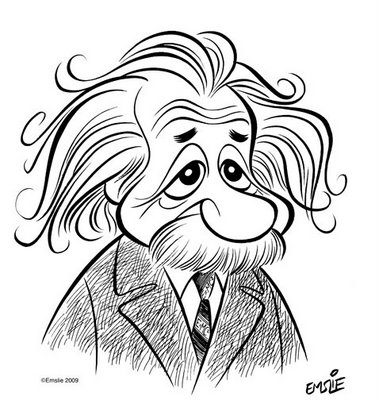
So, as I promised you all, I shall be blogging about Einstein. So here's the first post on the mastermind :)
More like a biography.


Albert Einstein was born at Ulm, in Württemberg, Germany, on March 14, 1879. Six weeks later the family moved to Munich, where he later on began his schooling at the Luitpold Gymnasium. Later, they moved to Italy and Albert continued his education at Aarau, Switzerland and in 1896 he entered the Swiss Federal Polytechnic School in Zurich to be trained as a teacher in physics and mathematics. In 1901, the year he gained his diploma, he acquired Swiss citizenship and, as he was unable to find a teaching post, he accepted a position as technical assistant in the Swiss Patent Office. In 1905 he obtained his doctor's degree.


During his stay at the Patent Office, and in his spare time, he produced much of his remarkable work and in 1908 he was appointed Privatdozent in Berne. In 1909 he became Professor Extraordinary at Zurich, in 1911 Professor of Theoretical Physics at Prague, returning to Zurich in the following year to fill a similar post. In 1914 he was appointed Director of the Kaiser Wilhelm Physical Institute and Professor in the University of Berlin. He became a German citizen in 1914 and remained in Berlin until 1933 when he renounced his citizenship for political reasons and emigrated to America to take the position of Professor of Theoretical Physics at Princeton*. He became a United States citizen in 1940 and retired from his post in 1945.

Tuesday, 8 May 2012

Yes, I have changed my blog address, blog name and also the blog content. I have been blogging about Newton for 3 months now. Recently, I read a few articles about Albert Einstein. And then I thought - why not blog about him too? He is one of the greatest scientists there have been, with an impeccable sense of humor.
He has made many contributions to Physics, like Newton.
It's gonna be a fun ride, blogging about these two amazing men.
Hope you'll like it.
Cheers!

Newton vs Einstein - another blogger's view


An interesting article I found online. Very well written, I must say!

When people think of scientific genius, two names immediately come to mind: Einstein and Newton. While it is still widely debated which was actually the more ingenius of the two (as if it really mattered), scientists agree on one thing: it's purely a two-man race. The intellects and achievements of all the other great scientists can hardly be considered mediocre, but none can measure up to the impossible brilliance of these two. Einstein and Newton were to the other guys what ordinary geniuses are to us.
The differences between Einsteinian and Newtonian physics all boil down to two basic concepts: space and time. Newton's space and time were absolute, that is, unchangable. Space was boundless, static, and completely empty save for the universal medium, the ether, and time had flowed inexoribly since Creation. Einstein's space and time, however, wound and twisted about one another into one absolute concept, spacetime. In Einstein's universe, space and time were continually being warped and shaped according to the motions of energy and matter.
Before Newton's time, people were utter mystifyed by the motion of the stars in the heavens, inventing elaborate explainations involving gods and imbedded spheres and the such. But Newton found that his theory of gravity explained their motions almost perfectly. Only such a superb mind as his could have equated the force that acts on an apple falling from a tree to that which keeps the Earth in orbit around the sun. Newton's gravity was a force carried in a universal medium called the luminous ether by which every object in the universe affects every other. Although a few scattered objections persisted, Newton's laws were so successful in explaining the motions of the planets that his concepts were universally accepted.
Einstein, however, abolished all that, saying that gravity was not a force at all, but merely the observed effect of the warping of space and time by matter. He examined two situations: resting on the surface of a massive body and accelerating in empty space. If the rate of acceleration was adjusted correctly, a person would feel the same downward pull of gravity. Einstein asserted that these effects were actually the same. A far cry from Newton's view of gravity as a force acting at a distance!
We have already observed the slowdown of time and the redshifting of light due to gravity. In Einstein's universe, these two phenomena naturally occur together. The newtonian physicist, however, would not also predict that time flows slower with stronger gravity, because Newton's time did not change.
For many centuries, astronomers have noticed a small discrepancy in Mercury's observed orbit around the sun and that predicted by Newton's laws. Because it is so close to the Sun, the Sun's mass distorts Mercury's path, so that with each revolution, its perihelion (closest point to the Sun) gets a closer to the Sun. On Newton's theory had predicted a shift only half as large as the actual one, but Einstein's predictions perfectly matched observations.
The difference between Newton's and Einstein's laws at ordinary speeds is negligably small, and Newton's laws are much simpler to use, so depite their inaccuracies, Newton's laws are still used for calculating in everday situations. However, many keys to understanding the universe lie not in ordinary experience, but in extraodinary phenomena such as supernovae and black holes. In the realms of the very big and very small, Newton's laws simply did not suffice.


Newton vs Einstein - who's the better scientist?
Comments are welcome. =)

Sunday, 6 May 2012

Newton's Flaming Laser Sword :P


Newton's flaming laser sword (NFLS) is a philosophical razor devised by Mike Alder in an essay (Newton's Flaming Laser Sword or: Why mathematicians and scientists don't like philosophy but do it anyway) on the conflicting positions of scientists and philosophers on epistemology and knowledge. Alder strongly criticized what he sees as the disproportionate influence of Greek philosophy—especially Platonism—in modern philosophy, and thus created a new razor to counter it. He contrast the scientist's Popperian approach to the philosopher's Platonic approach, which he describes as pure reason. The razor can be summarized as "what cannot be settled by experiment is not worth debating".
The razor is humorously named after Isaac Newton, as it is inspired by Newtonian thought, and is "much sharper and more dangerous than Occam's Razor", according to Alder. The essay was published in Philosophy Now in May/June 2004.

Essay

In his essay, Alder writes that the average scientist does not hold philosophy in high regard, "somewhere between sociology and literary criticism". He illustrates this with the example of the irresistible force paradox.