If A is success in life, then A = X+Y+Z. X is work, Y is play and Z is keeping your mouth shut.
Showing posts with label Einstein. Show all posts
Showing posts with label Einstein. Show all posts
Monday, 14 May 2012

Sunday, 13 May 2012
10 strange facts about Albert Einstein
So you think you know Albert Einstein: the absent-minded genius who gave us the theory of relativity (two of them, in fact, special theory and general theory of relativity), but did you know that Einstein was born with such a large head that his mother thought he was deformed? Or that Einstein had a secret child before he was married?
Read on for more obscure facts about the life of the world’s smartest genius:
1. Einstein Was a Fat Baby with Large Head
When Albert’s mother, Pauline Einstein gave birth to him, she thought that Einstein’s head was so big and misshapen that he was deformed!
As the back of the head seemed much too big, the family initially considered a monstrosity. The physician, however, was able to calm them down and some weeks later the shape of the head was normal. When Albert’s grandmother saw him for the first time she is reported to have muttered continuously "Much too fat, much too fat!" Contrasting all apprehensions Albert grew and developed normally except that he seemed a bit slow."
2. Einstein Had Speech Difficulty as a Child
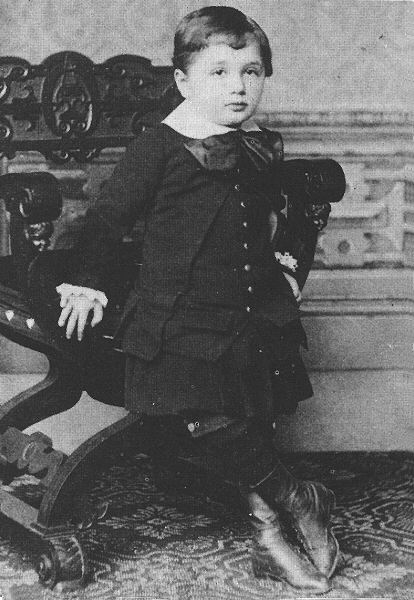
As a child, Einstein seldom spoke. When he did, he spoke very slowly – indeed, he tried out entire sentences in his head (or muttered them under his breath) until he got them right before he spoke aloud. According to accounts, Einstein did this until he was nine years old. Einstein’s parents were fearful that he was retarded – of course, their fear was completely unfounded!
One interesting anecdote, told by Otto Neugebauer, a historian of science, goes like this:
As he was a late talker, his parents were worried. At last, at the supper table one night, he broke his silence to say, "The soup is too hot."
Greatly relieved, his parents asked why he had never said a word before.
Albert replied, "Because up to now everything was in order."
In his book, Thomas Sowell [wiki] noted that besides Einstein, many brilliant people developed speech relatively late in childhood. He called this condition The Einstein Syndrome.
3. Einstein was Inspired by a Compass
When Einstein was five years old and sick in bed, his father showed him something that sparked his interest in science: a compass.
When Einstein was five years old and ill in bed one day, his father showed him a simple pocket compass. What interested young Einstein was whichever the case was turned, the needle always pointed in the same direction. He thought there must be some force in what was presumed empty space that acted on the compass. This incident, common in many "famous childhoods," was reported persistently in many of the accounts of his life once he gained fame.
4. Einstein Failed his University Entrance Exam
In 1895, at the age of 17, Albert Einstein applied for early admission into the Swiss Federal Polytechnical School (Eidgenössische Technische Hochschule or ETH). He passed the math and science sections of the entrance exam, but failed the rest (history, languages, geography, etc.)! Einstein had to go to a trade school before he retook the exam and was finally admitted to ETH a year later.
5. Einstein had an Illegitimate Child
In the 1980s, Einstein’s private letters revealed something new about the genius: he had an illegitimate daughter with a fellow former student Mileva Marić (whom Einstein later married).
In 1902, a year before their marriage, Mileva gave birth to a daughter named Lieserl, whom Einstein never saw and whose fate remained unknown:
Mileva gave birth to a daughter at her parents’ home in Novi Sad. This was at the end of January, 1902 when Einstein was in Berne. It can be assumed from the content of the letters that birth was difficult. The girl was probably christianised. Her official first name is unknown. In the letters received only the name “Lieserl” can be found.
The further life of Lieserl is even today not totally clear. Michele Zackheim concludes in her book “Einstein’s daughter” that Lieserl was mentally challenged when she was born and lived with Mileva’s family. Furthermore she is convinced that Lieserl died as a result of an infection with scarlet fever in September 1903. From the letters mentioned above it can also be assumed that Lieserl was put up for adoption after her birth.
In a letter from Einstein to Mileva from September 19, 1903, Lieserl was mentioned for the last time. After that nobody knows anything about Lieserl Einstein-Maric.
6. Einstein Became Estranged From His First Wife, then Proposed a Strange "Contract"
After Einstein and Mileva married, they had two sons: Hans Albert and Eduard. Einstein’s academic successes and world travel, however, came at a price – he became estranged from his wife. For a while, the couple tried to work out their problems – Einstein even proposed a strange "contract" for living together with Mileva:
The relationship progressed. Einstein became estranged from his wife. The biography reprints a chilling letter from Einstein to his wife, a proposed "contract" in which they could continue to live together under certain conditions. Indeed that was the heading: "Conditions."
A. You will make sure,
1. that my clothes and laundry are kept in good order;
2. that I will receive my three meals regularly in my room;
3. that my bedroom and study are kept neat, and especially that my desk is left for my use only.
B. You will renounce all personal relations with me insofar as they are not completely necessary for social reasons…
There’s more, including "you will stop talking to me if I request it." She accepted the conditions. He later wrote to her again to make sure she grasped that this was going to be all-business in the future, and that the "personal aspects must be reduced to a tiny remnant." And he vowed, "In return, I assure you of proper comportment on my part, such as I would exercise to any woman as a stranger."
7. Einstein didn't Get Along with His Oldest Son
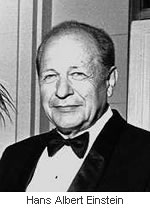 After the divorce, Einstein’s relationship with his oldest son, Hans Albert, turned rocky. Hans blamed his father for leaving Mileva, and after Einstein won the Nobel Prize and money, for giving Mileva access only to the interest rather than the principal sum of the award – thus making her life that much harder financially.
The row between the father and son was amplified when Einstein strongly objected to Hans Albert marrying Frieda Knecht:
In fact, Einstein opposed Hans’s bride in such a brutal way that it far surpassed the scene that Einstein’s own mother had made about Mileva. It was 1927, and Hans, at age 23, fell in love with an older and – to Einstein – unattractive woman. He damned the union, swearing that Hans’s bride was a scheming woman preying on his son. When all else failed, Einstein begged Hans to not have children, as it would only make the inevitable divorce harder. … (Source: Einstein A to Z by Karen C. Fox and Aries Keck, 2004)
Later, Hans Albert immigrated to the United States became a professor of Hydraulic Engineering at UC Berkeley. Even in the new country, the father and son were apart. When Einstein died, he left very little inheritance to Hans Albert.
To know more about Hans Albert Einstein, click here.
8. Einstein was a Ladies’ Man
 |
| Einstein with his second wife and cousin, Elsa |
After Einstein divorced Mileva (his infidelity was listed as one of the reasons for the split), he soon married his cousin Elsa Lowenthal. Actually, Einstein also considered marrying Elsa’s daughter (from her first marriage) Ilse, but she demurred:
Before marrying Elsa, he had considered marrying her daughter, Ilse, instead. According to Overbye, “She (Ilse, who was 18 years younger than Einstein) was not attracted to Albert, she loved him as a father, and she had the good sense not to get involved. But it was Albert’s Woody Allen moment.”
Unlike Mileva, Elsa Einstein’s main concern was to take care of her famous husband. She undoubtedly knew about, and yet tolerated, Einstein’s infidelity and love affairs which were later revealed in his letters:
Previously released letters suggested his marriage in 1903 to his first wife Mileva Maric, mother of his two sons, was miserable. They divorced in 1919, and he soon married his cousin, Elsa. He cheated on her with his secretary, Betty Neumann.
In the new volume of letters released on Monday by Hebrew University in Jerusalem, Einstein described about six women with whom he spent time and from whom he received gifts while being married to Elsa.
Some of the women identified by Einstein include Estella, Ethel, Toni and his "Russian spy lover," Margarita. Others are referred to only by initials, like M. and L.
"It is true that M. followed me (to England) and her chasing after me is getting out of control," he wrote in a letter to Margot in 1931. "Out of all the dames, I am in fact attached only to Mrs. L., who is absolutely harmless and decent."
9. Einstein, the War Pacifist, Urged FDR to Build the Atom Bomb

Re-creation of Einstein and Szilárd signing the famous letter to President Franklin Roosevelt in 1939.
In 1939, alarmed by the rise of Nazi Germany, physicist Leó Szilárd [wiki] convinced Einstein to write a letter to president Franklin Delano Roosevelt warning that Nazi Germany might be conducting research into developing an atomic bomb and urging the United States to develop its own.
The Einstein and Szilárd’s letter was often cited as one of the reasons Roosevelt started the secret Manhattan Project to develop the atom bomb, although later it was revealed that the bombing of Pearl Harbor in 1941 probably did much more than the letter to spur the government.
Although Einstein was a brilliant physicist, the army considered Einstein a security risk and (to Einstein’s relief) did not invite him to help in the project.
10. The Saga of Einstein’s Brain: Pickled in a Jar for 43 Years and Driven Cross Country in a Trunk of a Buick!
After his death in 1955, Einstein’s brain was removed – without permission from his family – by Thomas Stoltz Harvey, the Princeton Hospital pathologist who conducted the autopsy. Harvey took the brain home and kept it in a jar. He was later fired from his job for refusing to relinquish the organ.
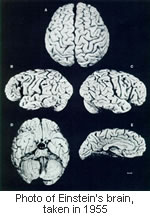 Many years later, Harvey, who by then had gotten permission from Hans Albert to study Einstein’s brain, sent slices of Einstein’s brain to various scientists throughout the world. One of these scientists was Marian Diamond of UC Berkeley, who discovered that compared to a normal person, Einstein had significantly more glial cells in the region of the brain that is responsible for synthesizing information.
In another study, Sandra Witelson of McMaster University found that Einstein’s brain lacked a particular "wrinkle" in the brain called the Sylvian fissure. Witelson speculated that this unusual anatomy allowed neurons in Einstein’s brain to communicate better with each other. Other studies had suggested that Einstein’s brain was denser, and that the inferior parietal lobe, which is often associated with mathematical ability, was larger than normal brains.
The saga of Einsteins brain can be quite strange at times: in the early 1990s, Harvey went with freelance writer Michael Paterniti on a cross-country trip to California to meet Einstein’s granddaughter. They drove off from New Jersey in Harvey’s Buick Skylark with Einstein’s brain sloshing inside a jar in the trunk! Paterniti later wrote his experience in the book Driving Mr. Albert: A Trip Across America with Einstein’s Brain
In 1998, the 85-year-old Harvey delivered Einstein’s brain to Dr. Elliot Krauss, the staff pathologist at Princeton University, the position Harvey once held:
… after safeguarding the brain for decades like it was a holy relic — and, to many, it was — he simply, quietly, gave it away to the pathology department at the nearby University Medical Center at Princeton, the university and town where Einstein spent his last two decades.
"Eventually, you get tired of the responsibility of having it. … I did about a year ago," Harvey said, slowly. "I turned the whole thing over last year [in 1998]."
PS : I do not own the images.
Einstein's field equations
The Einstein field equations are the 16 coupled hyperbolic-elliptic nonlinear partial differential equations that describe the gravitational effects produced by a given mass in general relativity. As result of the symmetry of
 and
and  , the actual number of equations reduces to 10, although there are an additional four differential identities (the Bianchi identities) satisfied by
  , one for each coordinate.
The Einstein field equations state that
 |
 is the stress-energy tensor, and
 |
 the Ricci curvature tensor and
  the scalar curvature.
The opening sequence of the 2003 French film Les Triplettes de Belleville (The Triplets of Belleville) features the Einstein field equations.

Friday, 11 May 2012
Einstein's equation of Life and Death
 In the summer of 1939 Albert Einstein was on holiday in a small resort town on the tip of Long Island. His peaceful summer, however, was about to be shattered by a visit from an old friend and colleague from his years in Berlin. The visitor was the physicist Leo Szilard. He had come to tell Einstein that he feared the Nazis could soon be in possession of a terrible new weapon and that something had to be done.
Szilard believed that recent scientific breakthroughs meant it was now possible to convert mass into energy. And that this could be used to make a bomb. If this were to happen, it would be a terrible realisation of the law of nature Einstein had discovered some 34 years earlier. September 1905 was Einstein’s ‘miracle year’. While working as a patents clerk in the Swiss capital Berne Einstein submitted a three-page supplement to his special theory of relativity, published earlier that year. In those pages he derived the most famous equation of all time; e=mc², energy is equal to mass multiplied by the speed of light squared.
The equation showed that mass and energy were related and that one could, in theory, be transformed into the other. But because the speed of light squared is such a huge number, it meant that even a small amount of mass could potentially be converted into a huge amount of energy. Ever since the discovery of radioactivity in the late 19th century, scientists had realised that the atomic nucleus could contain a large amount of energy. Einstein’s revolutionary equation showed them, for the first time, just how much there was.
Watch the first part of the documentary and follow up the later parts on YouTube :)
Source : bbc.co.uk
Theory Of Relativity
Albert Einstein was one of the greatest, if not the greatest physicist the world has ever known. His greatest achievement was his Theory of Relativity, which tells us about many things, including what would happen to our view of the world if we could travel very fast.
"Very fast" here does not mean something like 100 miles per hour, or even as fast an a 747 airplane, or the Space Shuttle. Very fast here means, close to the speed of light, which is 186,000 miles per second, or 300,000,000 meters/second, or about 1 foot every nanosecond. This page will try to show you what a house might look like if you flew by is at one of these "near speed of light" speeds.
First off though, how is it that you can see a house? Take a look at the picture below :

You can't see anything if there's no light, so here, the Sun is illuminating the house. Notice that some of the Sun's light rays bounce off of the house and into your eyes. It is through these rays that you are able to see the house.
Now, light rays travel at the speed of light (obviously). What would happen if you were moving to the right at very near the speed of light? It seems like you'd sort of be racing with the light rays bouncing off of the house. They'd have a hard time catching you to get into your eyes! Also, rays that have to travel greater distances (like the one that bounces off of the bottom of the house) wouldn't even catch you until a bit later than the rest!
All of this provides for some interesting views of the world while moving "very fast."
Wednesday, 9 May 2012
Einstein - the first :)
 So, as I promised you all, I shall be blogging about Einstein. So here's the first post on the mastermind :)
More like a biography.
Albert Einstein was born at Ulm, in Württemberg, Germany, on March 14, 1879. Six weeks later the family moved to Munich, where he later on began his schooling at the Luitpold Gymnasium. Later, they moved to Italy and Albert continued his education at Aarau, Switzerland and in 1896 he entered the Swiss Federal Polytechnic School in Zurich to be trained as a teacher in physics and mathematics. In 1901, the year he gained his diploma, he acquired Swiss citizenship and, as he was unable to find a teaching post, he accepted a position as technical assistant in the Swiss Patent Office. In 1905 he obtained his doctor's degree.
During his stay at the Patent Office, and in his spare time, he produced much of his remarkable work and in 1908 he was appointed Privatdozent in Berne. In 1909 he became Professor Extraordinary at Zurich, in 1911 Professor of Theoretical Physics at Prague, returning to Zurich in the following year to fill a similar post. In 1914 he was appointed Director of the Kaiser Wilhelm Physical Institute and Professor in the University of Berlin. He became a German citizen in 1914 and remained in Berlin until 1933 when he renounced his citizenship for political reasons and emigrated to America to take the position of Professor of Theoretical Physics at Princeton*. He became a United States citizen in 1940 and retired from his post in 1945.
Wednesday, 22 February 2012
LMFAO! xD
All the physicists are playing hide and seek. Einstein is the ‘den’ and stands against the wall with his eyes closed and counts till 100 to enable all the physicists to run and hide. At the count of 100 Einstein turns around and finds Newton standing there.
...............
Subscribe to:
Posts (Atom)